
Ghost Employee, Part 2
The Gate That Was Never Open

This is Part 2 of the Ghost Employee series. Read Part 1 here.
You already know this story.
You spent hours tailoring the resume. You answered the screening questions. You may have even taken the assessment — thirty minutes on personality traits and cognitive patterns — and submitted everything they asked for.
You got the confirmation email.
You checked again. Crickets.
Not a follow-up. Not a rejection. Just the confirmation — and then silence other than your mouse clicks.
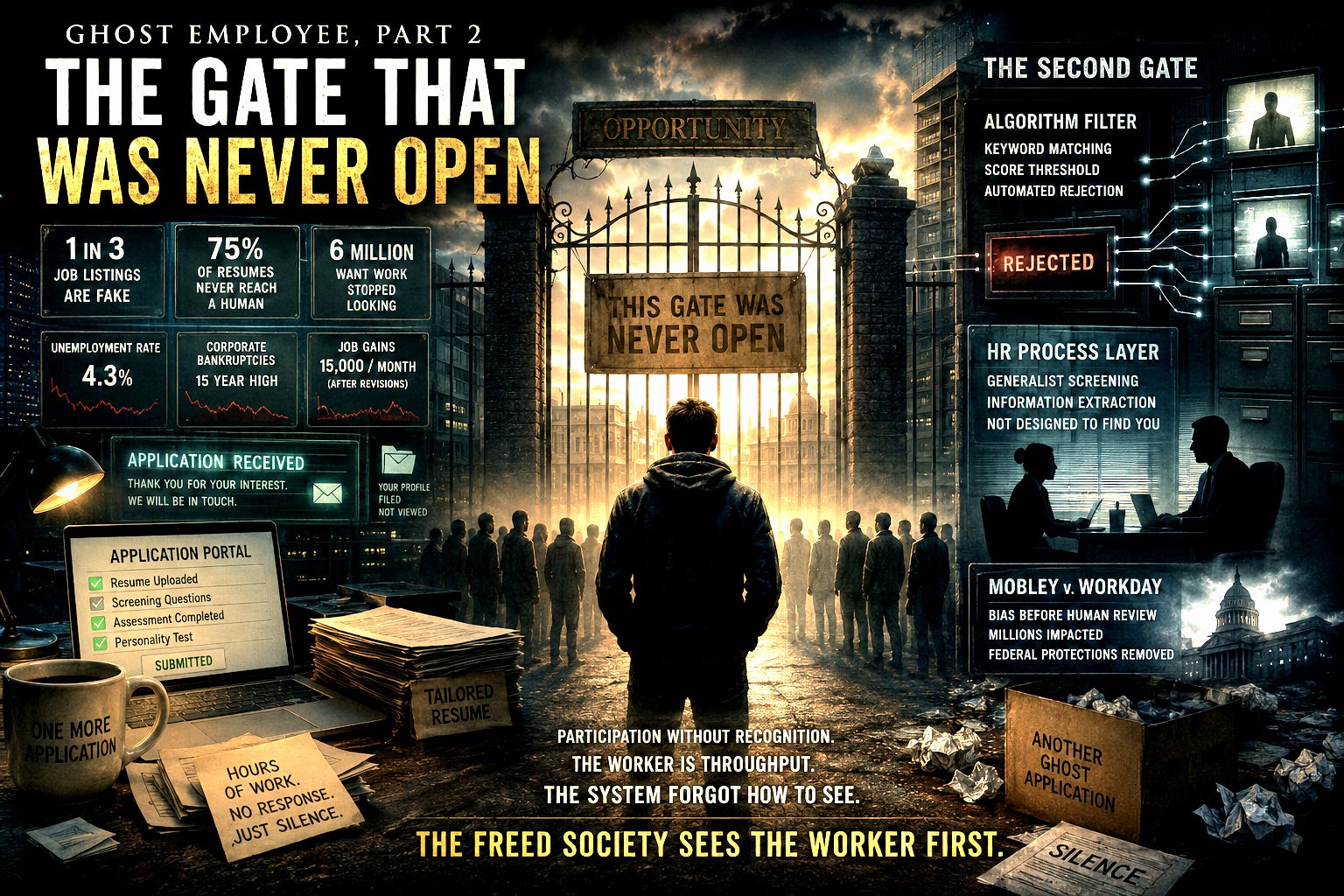
Here is what the data now confirms about that experience: there is a one in three chance the job was never real. The posting existed. The application portal accepted your information — potentially after you received your last paycheck for months. The assessment collected your data. And somewhere in a database you will never access, your profile sits alongside millions of others — gathered, scored, and filed for a position that was never going to be filled.
You already knew it. Now you can prove it. But there is much more.
The Numbers That Don't Add Up
The official unemployment rate says 4.3 percent. Corporate bankruptcies are at a fifteen-year high. Job gains averaged 15,000 per month after revisions — in an economy that requires multiples of that to absorb its workforce. More than 1,600 companies announced mass layoffs in the first three months of 2026 alone. The hiring rate sits 30 percent below 2021 levels while job postings remain artificially high — padded by listings that were never meant to be filled.
These numbers do not reconcile.
They cannot reconcile.
Because they are measuring different things.
The unemployment rate measures people actively searching. It does not measure the one in three job listings that are ghost jobs. It does not measure the 75 percent of resumes that never reach a human reviewer — filtered out by algorithms that reward formatting over qualification. It does not measure the contractor who lost their last client and has no unemployment insurance because the system that would protect them classified them as entrepreneurs instead of workers — by design, not by accident.
It does not measure the five million people who left the labor force entirely in a single year.
It does not measure the six million who want work and stopped looking — not because they gave up on themselves, but because the system made clear it had given up on them first. Applications into silence. Confirmation emails into nothing. Personality assessments for positions that didn't exist. Forty-five minutes of unpaid labor per application, multiplied across months, multiplied across hundreds of submissions, producing nothing but a database entry in a system the applicant will never access and cannot delete.
At some point the rational decision is to stop.
Not laziness. Calculation.
The search costs more than it returns. The dignity lost in the process is not returned when the process ends in silence. The savings drain. The bills do not pause. The grocery store does not offer a discouraged worker discount.
The extraction does not stop when you leave the labor force. It simply changes form.
These are the people the official numbers don't count. The ones on the cliff — losing balance, spending down whatever remains, still feeding the economy that rejected them at every transaction, still paying into a system that stopped paying attention to them the moment they stopped showing up in the data.
Many are doing it on their final paycheck — spending down everything they have. It takes nearly a year or more to find a job in this market. Most people don't know that when they start.
They didn't drop out because they were weak.
They dropped out because they were paying attention.
And while they were standing on that cliff — while the savings drained and the bills kept coming — the camera turned on. The finger pointed. The word came down from the people who built and protected this system:
Get off the couch!
The Second Gate
Assume the job was real.
Assume you made it past the ghost job odds.
There was still a gate you didn't know existed.
Ninety-nine percent of Fortune 500 companies run every application through an Applicant Tracking System before a human being sees it. The system parses your resume, scores it against keywords, and ranks you against every other applicant. If your score falls below a threshold — which you are never told — your resume becomes functionally invisible. A recruiter may never scroll far enough to find you.
The system is not an expert in your field. It is an expert in pattern matching. If the job description says "project management" and your resume says "program management" — the algorithm may not recognize them as the same thing. If your field uses FedRAMP and the template doesn't know FedRAMP, your thirty years of specialized experience registers as a gap. The more expert you are, the more likely your terminology diverges from whatever keyword list a non-expert assembled.
You are filtered out not because you were unqualified.
Because you were too qualified in ways the system wasn't built to recognize.
No explanation is required. No appeal exists. No law in most states demands that an employer tell you an algorithm made the decision, what criteria it applied, or that it touched your application at all.
The algorithm isn't the only gate.
Behind it sits another one.
The HR generalist who screens your call was hired for people skills and process management — not for thirty years of specialized systems engineering. They don't know FedRAMP. They don't know the difference between the role as posted and the role as the hiring manager actually needs it filled. They are doing their job. Their job was not designed to find you.
What they can do is extract your expertise during the screening call, understand enough of it to sound informed, and carry your knowledge into the next conversation — without you.
You educated the gatekeeper.
The gatekeeper got the credit.
You got the silence.
The specialist hired by a generalist, filtered by an algorithm built by neither, for a hiring manager receiving only what the system allowed through — that is not a personnel failure. That is a system producing exactly the outcome it was designed to produce: risk minimization over talent identification, process compliance over human judgment.
Nobody in that chain did anything wrong.
The worker still didn't get the job.
And if you were over forty — the Mobley v. Workday class action documents what happened next. Over one hundred applications submitted. Rejections delivered within minutes of submission — one at 1:50 a.m., less than an hour after the application was filed. Not by a person. By a system that evaluated protected characteristics before any human being made any decision. The court ordered Workday to produce its list of employer clients to a court administrator. Workday fought even that disclosure, arguing it would harm the company's competitive positioning.
Then the regulatory cop walked off the beat entirely. A 2025 executive order instructed federal agencies to eliminate or reduce pursuit of disparate-impact liability cases. The EEOC deprioritized exactly the type of claims Mobley is bringing. The case continues in federal court — without the federal government's support.
The gate was never announced.
It was never disclosed.
It was simply there — between your application and any human being who might have actually read it.
This is the design Chapter 12 of The Hidden Forces names: work stripped of dignity not during employment — but before it begins. The cage is built at the gate.
Participation Without Recognition
A system designed primarily to filter people eventually forgets how to recognize them.
That is the contradiction at the center of the modern labor market.
The economy claims to suffer labor shortages while millions of people move through automated hiring systems without ever reaching human evaluation. Applications are accepted. Assessments are completed. Data is collected. Participation is performed.
But recognition never arrives.
The worker experiences the process as opportunity.
The system experiences the worker as throughput.
That distinction changes everything.
Because the damage is no longer only economic. It is psychological. Civic. Social.
People begin understanding that effort and recognition have separated from one another. That participation no longer guarantees visibility. That entire procedural systems now exist between human beings and the institutions supposedly searching for them.
The confirmation email arrives instantly.
The silence arrives permanently.
And after enough repetitions, people stop interpreting the silence as personal failure.
They begin recognizing it as architecture.
The frightening part is how invisible the transition was. No public announcement declared that human evaluation would become secondary to automated filtration. No law required disclosure. No major institution stood in front of the public and explained that millions of workers would now spend their lives interacting primarily with procedural systems rather than decision-makers.
It simply became normal.
The rejected worker became data.
The applicant became traffic.
The human became throughput.
And the system called this modernization.
But a civilization cannot automate recognition out of existence forever without consequences. Human potential does not disappear because an algorithm failed to score it correctly. It does not vanish because a keyword mismatch buried it beneath a thousand resumes. It does not cease to exist because an exhausted worker finally stopped applying after months of silence.
The capability remained.
The system failed to see it.
That distinction matters.
Chapter 18 of The Hidden Forces documents what the ghost employee becomes after the system finishes with them — not just unemployed, but erased from the count entirely. Because the solution is not merely creating more jobs. It is rebuilding systems capable of recognizing human beings before algorithmic filtration buries them beneath optimization layers designed primarily to minimize institutional risk.
What the Freed Society Does Instead
The system that exists was not designed to find the best person for the job. It was designed to manage risk, minimize liability, collect data, and protect the institutions that built it. The worker was never the point.
The freed society starts from a different premise.
You meet the baseline requirements. You get the job. You get trained — because training is an investment in the work, not a privilege extended to those who already have it. You do the job. You share in what the work produces. And if you can't do the job, the next person in line gets the opportunity you were given.
That is not radical. That is what work was supposed to be before it became a compliance test.
The cooperative model proves it works. When the people doing the work share in what the work produces, motivation doesn't require surveillance. Loyalty doesn't require manufactured fear. The ghost job doesn't exist because there is no advantage in posting one. The algorithm doesn't screen for age or keyword formatting because the people making hiring decisions are accountable to the same community the hire will join.
Six million people want to work and believe no job is available for them. They are not broken. They are not lazy. They made a rational calculation about a system that stopped being rational a long time ago.
Give them real work. Train them. Share the revenue. Watch what happens.
The freed society sees the worker first.
Before the keyword score.
Before the personality assessment.
Before the productivity prediction.
Before the gate.
Because a human being is not a resume ranking inside a procedural machine.
And systems that forget that eventually begin producing ghosts.
The gate was never open.
That does not mean it cannot be rebuilt.
See the design.
Name what it serves.
Then build differently.
Series 2 is live. Look for the new series of essays and sequels continuing. New essays drop when the news demands it. Subscribe so you don't miss what's coming.
The Hidden Forces: Reclaiming Humanity's Power from Systems of Control, Vol. 1 is available now.
Read it.
Share it.
Build the freed society. 🦅
[Read the Book] | [Sign the Resolution] | [Support the Mission]