
Monopoly by Design
What Happens When Profit Becomes the Only Purpose

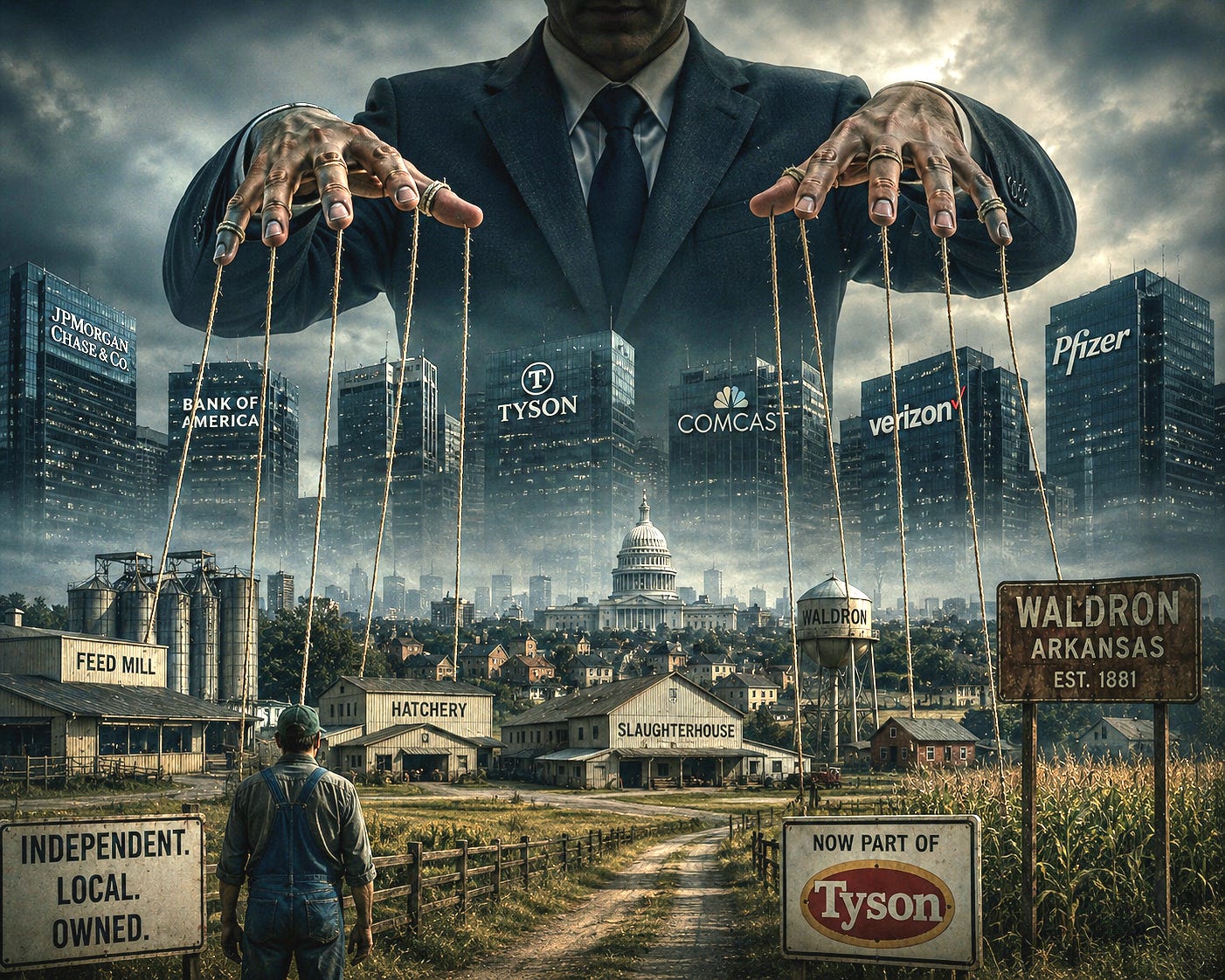
The disease is not monopoly. Monopoly is what the disease builds when left to run long enough without check. Understanding that distinction is the difference between treating a symptom and naming what produces it — and fifty years of treating the symptom while the disease continued its work has brought us to a moment when the concentration of economic power across every major industry in America is no longer a warning. It is a result.
The Town That Used to Be Whole
Waldron, Arkansas is where this essay begins. Not in a courtroom. Not in a congressional hearing. In a town that used to be whole.
Waldron had what every community needs to sustain itself — independent farmers who owned their land and their decisions, a local slaughterhouse, a hatchery, a feed mill, businesses owned by people whose children went to school there, whose money circulated through the community before it ever left, who had a stake in the place because the place was theirs. The wealth that the land and the labor produced stayed close enough to the ground to do some good. Then Tyson Foods arrived. Not with force. With acquisition. One by one the businesses the community depended on were purchased and absorbed into a single corporate structure. Farmers who had once sold to whoever offered the best price found themselves locked into contracts whose terms they did not negotiate and could not escape. The slaughterhouse, the hatchery, the feed mill — all of it folded into the same ownership, the same balance sheet, the same obligation to shareholders who had never set foot in Waldron and never would. The wealth that had once circulated through the town began moving in one direction. Out. As Christopher Leonard documented in The Meat Racket, Tyson’s vertical integration of Waldron was not an aberration. It was the model — replicated across rural America wherever the philosophy that drove it had enough runway and enough capital to complete its work.
The Disease Has a Name
That philosophy was declared publicly, in the New York Times, by the economist Milton Friedman. His argument was simple and total: the social responsibility of business is to increase its profits. Not to serve workers. Not to sustain communities. Not to consider the health of the country it operated inside. Shareholders. That was the obligation — the only obligation — and any executive who spent corporate resources on anything else was, in Friedman’s own words, stealing from the people who owned the company. It was not presented as greed. It was presented as moral clarity. A permission structure dressed as an ethical principle, telling an entire generation of executives that extraction without limit was not just acceptable. It was their duty.
What philosophy declared, strategy operationalized. Eleven months after Friedman’s essay, Lewis Powell — corporate lawyer, soon to be Supreme Court Justice — sent a confidential memorandum to the U.S. Chamber of Commerce arguing that business was losing the war of ideas and that the response needed to be organized, sustained, and aggressive. Fund think tanks to produce intellectual justification. Place corporate-friendly voices in universities and media. Build legal organizations to fight regulation in court. Flood Washington with lobbyists until the rules of competition were written by the people who benefited most from weakening them. In 1971 there were 175 companies with registered lobbyists in Washington. By 1980 there were nearly 2,500. The infrastructure Powell envisioned became reality within a decade, and by the 1980s maximizing shareholder value had become the organizing principle of American business — executive compensation tied to stock prices, hostile takeovers punishing any leader who prioritized workers or communities over quarterly returns. The Architects of Inversion — Week 4 of The Hidden Forces, now in the paid archive — traced this blueprint in full detail. What this essay names is what the blueprint produced when left to run for fifty years.
What the Philosophy Builds
When profit is declared the sole purpose of the machine and the systems designed to check concentrated power are captured by the same philosophy — monopoly becomes the path the market rewards most. Not inevitable in every case. Small businesses exist. Local economies survive. People build things for reasons beyond pure extraction every day. But the dominant direction, the gravitational pull of a system oriented entirely around shareholder return, moves consistently toward consolidation, acquisition, and control — because total control is the most efficient path to maximum extraction. Why compete when you can acquire? Why negotiate when you can dictate? Why share the ecosystem when you can own every layer of it simultaneously and collect a toll at every point of passage? That logic, applied across fifty years and every major industry, has produced something the market has no mechanism to reverse on its own — because the philosophy enabling it remains intact.
Four meatpacking corporations now control 85 percent of beef processing. Four banks control 41 percent of all U.S. banking assets. Five telecom companies control 90 percent of broadband and mobile services. Six companies control 90 percent of American media — in 1983 it took fifty to reach that share. Between 1997 and 2012, 72,000 small manufacturers shut down, 108,000 local retailers closed, and 13,000 community banks disappeared. Live Nation and Ticketmaster controlled 80 percent of concert ticketing, owned or operated the majority of major venues, and had absorbed enough of the promotion business that artists, venues, fans, and competitors found themselves captive — overcharged by $1.72 per ticket at major venues while the company collected its toll at every layer of the stack.
The Harm Has Addresses
The harm this produces is not abstract. It has addresses.
Paul Coleman worked at the Luke Paper Mill on the Maryland-West Virginia border for nearly thirty years. At its height the mill employed more than 2,000 people and was the only business that mattered in those small towns — the economic center around which everything else organized itself. When consolidation and corporate calculation made the mill no longer worth operating, 700 people lost their jobs in a single closure. Coleman’s unemployment ran out. His health insurance ran out. At 62 he understood that no one was going to hire him. He dipped into his 401k to survive while the bills accumulated. The man who had supplied coal to the mill for decades was forced to lay off his own workers and described his situation as doing odd jobs, whatever he could pick up on the side — not just losing income but losing the future he had spent a working life building toward. The silence where the mill used to run, he said, was eerie. You knew everything was alright when you could hear it.
The farmer in Waldron lost his independence before he lost his income. That sequence matters. The contract arrived first — terms set by the company that now owned everything above and below him in the chain, prices it determined, conditions it enforced, with no competing buyer to appeal to and no alternative market to turn toward. When a labor market reaches high concentration wages fall by 17 percent — not because workers produce less but because the concentrated employer no longer needs to pay fairly. It only needs to pay enough to keep workers from leaving, and when there is only one employer in the county that number can be kept very low. The monopoly does not innovate — it acquires smaller competitors before they become threats, ensuring the next generation of builders never gets the chance. And it makes the broader economy structurally fragile in ways that become visible only in crisis: when four meatpacking corporations control 85 percent of beef processing, a disruption at two plants produces shortages across the entire country, because the efficiency the monopoly promised was never efficiency at all. It was concentration masquerading as optimization, and when it breaks, everyone inside the system pays the price.
When Decentralized Checks Are Utilized
What concentrated economic power without check produces in the life of a community is what concentrated political power without check produces in the life of a nation — the slow hollowing of the institutions designed to distribute it, the capture of the mechanisms built to constrain it, and the eventual disappearance of the alternatives that gave the people inside it somewhere else to turn. The founders understood this about political power clearly enough that they built an entire architecture of distributed authority to prevent it. The same principle applies to economic power, and the same neglect that allows political institutions to be captured allows economic ones to be consumed — until the Common Man finds himself with no meaningful choice in the industries that govern the most fundamental conditions of his life.
Which is precisely why what thirty-three states and the District of Columbia did matters beyond the verdict itself. The federal Department of Justice filed suit against Live Nation and then settled — walked away from the case it had brought, decided the fight wasn’t worth finishing. Thirty-three states disagreed. They picked up the case independently, coordinated across sovereign lines without waiting for federal permission or federal leadership, and carried it to a jury that found Live Nation liable on every count. This is the founders’ design functioning as intended — decentralized sovereign power acting as a check on concentrated authority when the federal government fails to provide that check itself. The states did not petition Washington to act. They acted. And North Dakota had already demonstrated in a different industry what acting on the right principle looks like: by banning chain pharmacy monopolization within its borders, the state produced more pharmacies per capita than any other in the country, better prices, higher satisfaction, and measurably better health outcomes for its citizens. One state. One decision grounded in a principle oriented toward serving the population rather than accommodating the concentrated. A different result for the people living inside it.
Designed to Serve
The argument the book, The Hidden Forces, makes is not that competition is the answer to monopoly. Competition is not the golden key. A market populated by competing companies can extract from workers, hollow out communities, and consume its own population just as thoroughly as a monopoly — and call itself a free market while doing so. The number of players does not determine what the game is for. What Chapter 6 identifies as the operating disease is the inversion of the relationship between the machine and the human being inside it — the moment economics became the master and humanity became the servant, when the machine became the purpose and the human being became the input, the raw material the economy processes rather than the life the economy exists to serve. Chapter 8 names the consequence plainly: the free market is free only for those who can afford to shape it. And Chapter 28 identifies distribution of power not as a question of fairness but of survival — because a society in which one entity controls the supply chain of food, or medicine, or culture, or information is not a free society in any meaningful sense, regardless of what its founding documents say.
The freed society does not abolish profit. It refuses to make profit the only thing the machine serves. That refusal changes what the system rewards. And what the system rewards determines what it builds — for the farmer who needs a buyer, for the worker who needs an employer who cannot simply leave, for the town that needs its wealth to circulate before it leaves, for the human being who deserves the conditions to reach his full potential rather than a system engineered to extract from him until there is nothing left to take.
Waldron, Arkansas still exists. The independent slaughterhouse is gone. The hatchery is gone. The feed mill is gone. The contracts that once made a farmer his own man now make him a unit in someone else’s supply chain. But the principle that hollowed Waldron out has been named — in a courtroom by thirty-three states, in the data by every researcher who has traced what fifty years of profit-as-purpose built, and in the pages of a book written by a systems engineer who spent thirty years inside the machinery and came out the other side with one question the Friedman doctrine never answered.
What is the economy for?
The Principle of the Freed Society
The freed society does not begin with a market structure. It begins with a purpose. Not with an ideology. Not with a political program that has come before. With a principle that precedes all of them: the economy exists to serve the human being inside it. Every design decision — every policy, every institution, every question of concentration or distribution — gets measured against that standard. By that standard the profit-as-purpose principle has produced exactly what a machine built for extraction always produces when left to run without check.
The disease was never the monopoly. The monopoly is what the disease builds.
And what was built by design can be rebuilt by design.
See the design. Name what it serves.
And then decide what you will do with what you now know.
Series 2 is live. Look for the new series of essays and sequels continuing.
New essays drop when the news demands it. Subscribe so you don’t miss what’s coming.
The Hidden Forces: Reclaiming Humanity’s Power from Systems of Control, Vol. 1 is available now.
Read it.
Share it.
Build the freed society. 🦅
[Read the Book] | [Sign the Resolution] | [Support the Mission]